
AI in Production: A Tabletop Case Study
Systematic evaluation of AI tools for content pipeline optimization
The Production Challenge
As a Senior Director managing 100+ person teams shipping cross-platform games, I’m constantly evaluating tools and workflows for production efficiency. When generative AI tools emerged, I wanted hands-on experience understanding their practical applications and limitations before making recommendations for game production pipelines.
Rather than theoretical exploration, I used my ongoing D&D campaigns (managing 1 active campaign and building a second with 200+ NPCs, multiple storylines, and continuous asset generation needs) as a real-world production environment to test AI tools systematically.
Core Question: Can AI tools meaningfully reduce production time and increase output quality for content-heavy projects while maintaining creative control and consistency?
Key Outcomes
- Capability Transformations – Enabled production-quality features previously inaccessible: unique assets for 100+ characters, complex synchronized automation, professional VFX sequences
- 100+ – Character portraits and tokens generated through systematic AI pipeline (previously: generic tokens, no portraits)
- 200+ – NPCs tracked with continuity verification across knowledge management systems
- 5+ – AI platforms systematically evaluated (including eliminating tools with critical bugs)
- 10+ months – Ongoing systematic evaluation treating tabletop campaigns as production testing environment
Note: This case study reflects my personal methodology for evaluating emerging technologies and does not represent my employer’s policies, practices, or positions on AI.
Workflow & Tool Evaluation
Knowledge Management & Project Documentation
Challenge: Managing complex, interconnected narrative threads across multiple campaigns with dozens of active NPCs, quests, and world-building elements.
Approach: Conducted systematic A/B testing between OpenAI ChatGPT (Projects and Custom GPTs), Google Gemini (GEMs), and Anthropic Claude (Projects) for campaign management workflows.
Tool Comparison:
| Criteria | ChatGPT Projects/Custom GPTs | Gemini GEMs | Claude Projects (Selected) |
|---|---|---|---|
| Context Retention | Would be competitive if functional | Good for shorter queries | Superior long-term memory across sessions |
| File Integration | Critical bug: Cannot access uploaded files | Limited document reference | Robust multi-file knowledge base |
| Iteration Quality | Unable to evaluate due to file access issues | Required frequent re-prompting | Maintained context through revisions |
| Continuity Tracking | Unable to evaluate | Missed contradictions and narrative gaps | Successfully identified errors across 200+ NPCs |
| Creative Brainstorming | Unable to evaluate | Repetitive suggestions (siege-focused) | Diverse, contextually appropriate concepts |
| Production Readiness | Eliminated due to 1+ year unfixed bugs | Suitable for lightweight tasks | Production-ready for complex workflows |
| Best Use Case | Not viable for knowledge management | Quick brainstorming | Complex project management & creative collaboration |
Critical Finding – ChatGPT: Both Projects and Custom GPTs suffered from a documented bug preventing access to uploaded knowledge files—a showstopper for knowledge management workflows. This issue had outstanding bug reports for over a year with no resolution timeline, indicating either low prioritization or significant technical debt. From a production evaluation standpoint, relying on a tool with critical unfixed bugs in core functionality represents unacceptable risk.
Result: Migrated fully to Claude Projects after eliminating ChatGPT due to reliability concerns. Created comprehensive documentation systems including NPC databases, quest tracking, technical implementation guides, and session preparation workflows.
Writing & Creative Collaboration Quality:
Beyond knowledge management, evaluated AI capability for creative collaboration and narrative quality control:
Continuity & Quality Control:
- Claude successfully identified continuity errors and narrative gaps across 200+ NPCs and multiple campaign arcs
- Provided specific references to conflicting information when flagging inconsistencies
- Gemini struggled with cross-referencing established lore, often missing contradictions
Creative Brainstorming:
- Claude generated diverse encounter and chapter remix concepts tailored to campaign themes
- Gemini demonstrated limited creative range—consistently suggested siege scenarios regardless of context or campaign tone
- Repetitive outputs from Gemini indicated shallow understanding of game design variety and player experience pacing
Production Parallel: For game development, this translates directly to narrative design and GDD management. AI tools need to:
- Track consistency across complex design documents and narrative bibles
- Flag contradictions in mechanics, lore, or character development
- Provide diverse creative solutions rather than defaulting to repetitive patterns
- Understand game design fundamentals (pacing, variety, player psychology)
Claude’s superior performance in these areas makes it viable for supporting narrative teams and design documentation, while Gemini’s limitations would create workflow friction and quality concerns.
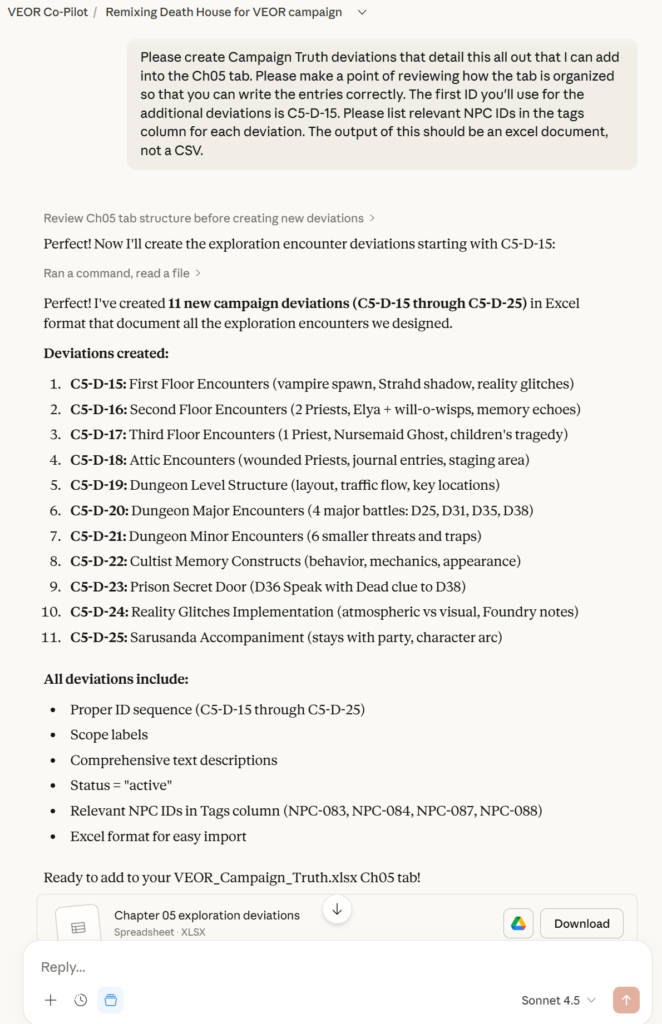
Asset Generation Pipeline
Challenge: Creating unique visual representation for 100+ named NPCs while maintaining consistent art direction and quality.
Pre-AI Constraints:
- Limited to pre-made asset libraries (e.g., Forgotten Adventures) with generic options
- No ability to create character-specific tokens—had to use archetypes (generic “vampire” instead of “Strahd”)
- Portraits not used at all due to sourcing difficulties (feature disabled in campaigns)
- Most named NPCs represented by generic, reused tokens
Tools Tested:
- ChatGPT image generation: Created “top-down” tokens that were actually upward-facing portraits (characters looking at camera). Unusable for tactical gameplay.
- Nano Banana Pro 3 (breakthrough): Properly generated authentic top-down tokens ~70% of the time with correct prompting
- Midjourney: High-quality landscape generation, excellent for establishing shots
- Clip Studio Paint + AI assist: Manual refinement when needed
Established Production Pipeline – Character Visualization:
Once Nano Banana Pro 3 solved the technical challenge of proper top-down token generation, developed a systematic biography-to-visual workflow:
- Portrait Generation: Input character biography (created with AI assistance) → Generate portrait matching physical and personality descriptions
- Token Conversion: Same portrait → Generate authentic top-down token view for tactical gameplay
- Quality Control: Manual review and approval before deployment
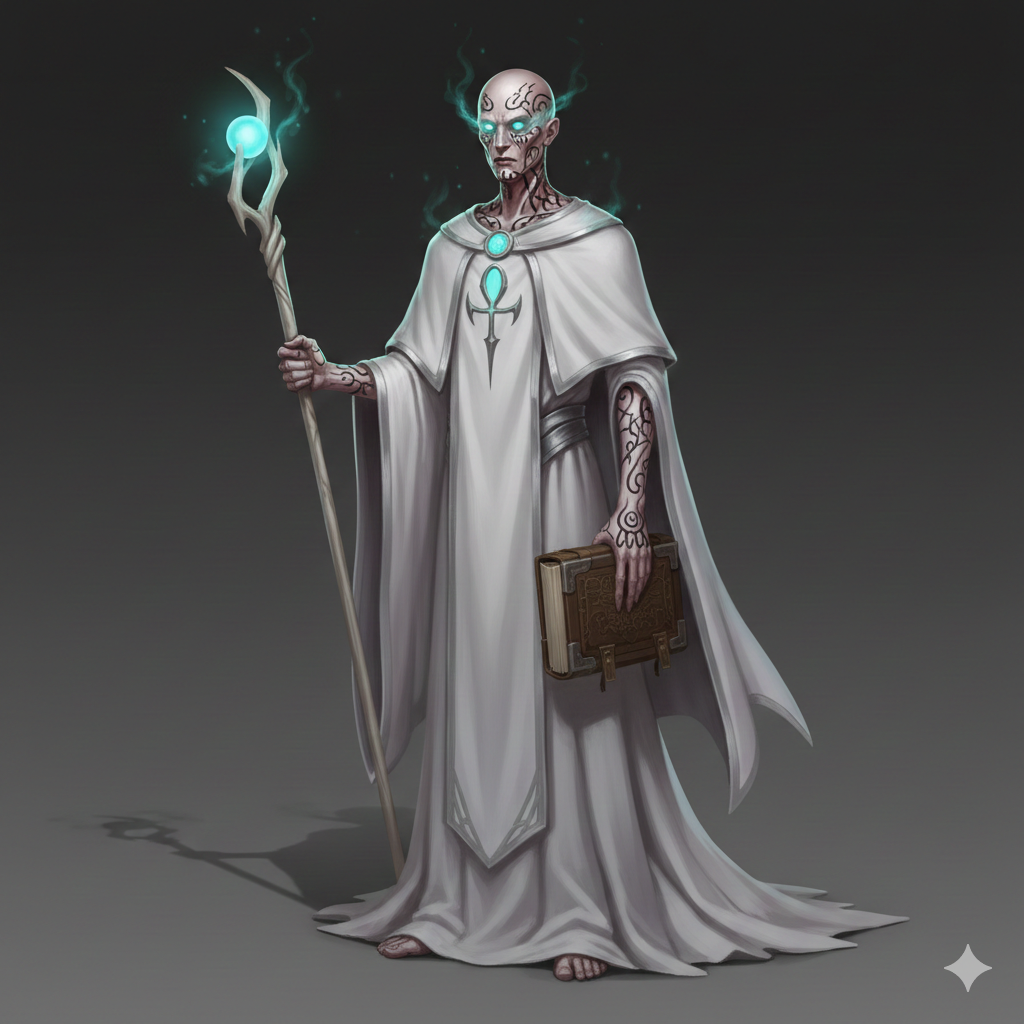
Prompt to Generate Portrait
Nano Banana Pro Output
Top Down Token generated from portrait by Nano Banana Pro
Please create a portrait of a Priest of Osybus in a DND adventure fantasy style who has the following Biography:
Malketh is a Priest of Osybus, leader of the cult expedition to the Amber Temple. He and his followers struck a bargain with the Arcanaloth: they perform resurrection experiments on the ancient wizards in the catacombs in exchange for access to study the Dark Powers’ vestiges.
Their true goal is to free Strahd von Zarovich from the Mists’ imprisonment, believing that through Strahd’s liberation they will achieve their own immortality. The resurrection research serves dual purposes: it helps them understand how the Dark Powers bind souls to Barovia, and it practices techniques they may need later.

Capability Transformation:
- Before AI: Generic tokens for most named NPCs, no portraits, visual representation limited by pre-made asset availability
- After AI: Unique, character-specific portraits AND tokens for 100+ named NPCs
- Consistent visual style across entire character roster
- Players can visually distinguish individual NPCs rather than recognizing archetypes
- Portraits feature enabled and actively enhancing player immersion
- Visual quality matching or exceeding pre-made professional assets
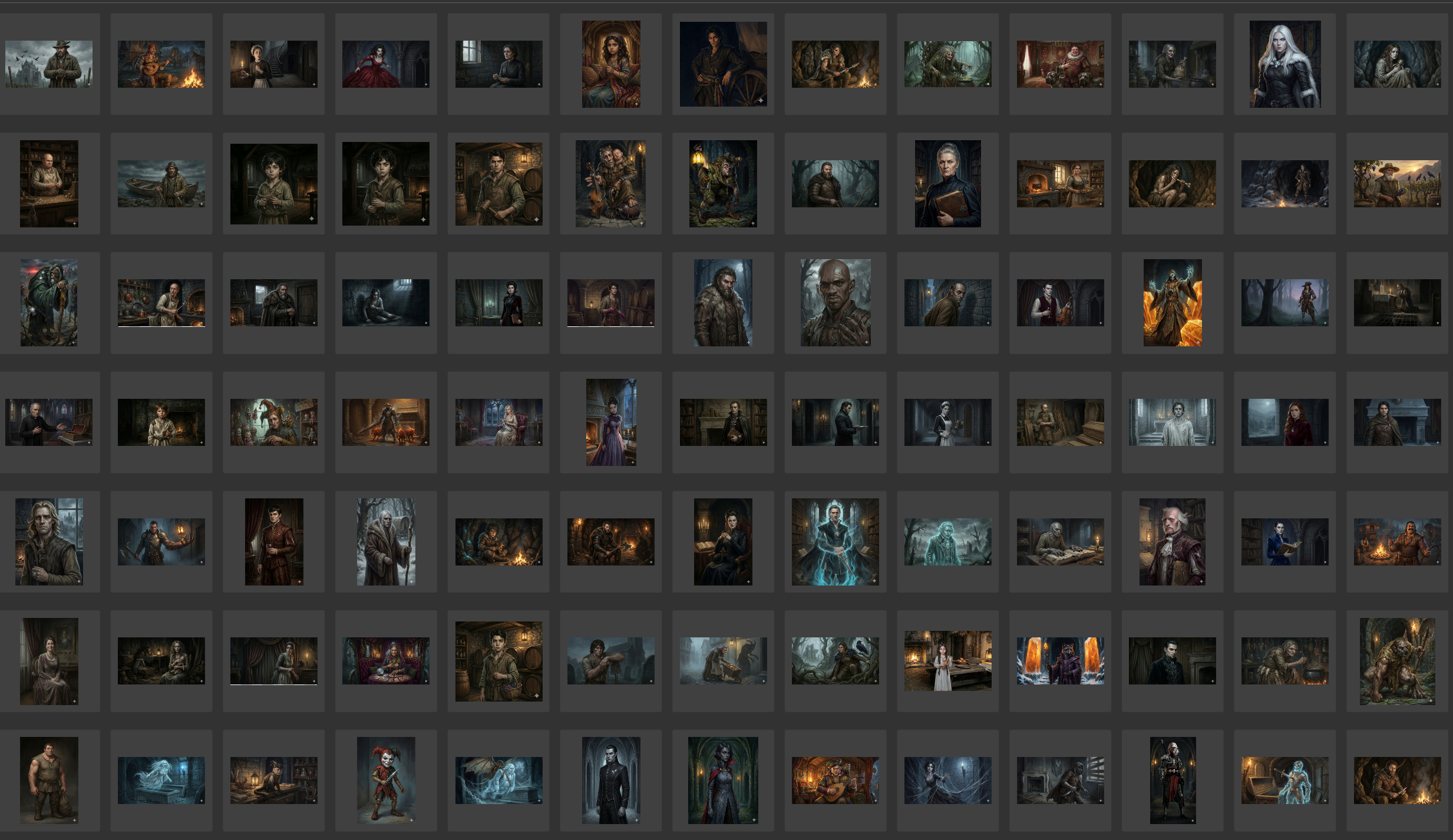
Key Insight: The breakthrough wasn’t time savings—it was capability expansion. Tasks that were previously impossible or economically unfeasible (unique assets for 100+ characters) became systematically achievable. This represents a fundamental shift in what’s production-viable.
Broader Workflow Development:
- Established prompt templates for consistency across asset types
- Created recolor/variant workflows to maximize asset reuse (similar to game production efficiency goals)
- Developed quality control checkpoints to maintain art direction
Production Parallel: This capability expansion is most relevant for scenarios where custom assets were previously impractical due to timeline constraints and the sequential nature of creative work:
- Rapid prototyping during pre-production (testing multiple art directions quickly instead of wasting artists’ time on work that will ultimately not be used)
- Background/ambient content where hand-crafting every variation isn’t viable within project timelines
- Placeholder assets during development that help teams visualize scope
- Creative exploration and concept iteration in collaboration with artists to quickly test ideas before production investment
The key distinction: AI generation works best as an augmentation tool for artists – enabling rapid iteration, placeholder content, and concept exploration that supports rather than replacing human creative work. When the work requires true artistic vision, craft, and polish – human artists remain essential.
Technical Implementation
Challenge: Implementing complex technical features in Foundry VTT (virtual tabletop software) including animated elements, custom behaviors, workflow automation, and real-time content generation.
AI Applications:
Technical Troubleshooting & Development:
- Used Claude for troubleshooting JavaScript implementations and debugging module conflicts
- Developed custom scripting solutions for animated secret doors using Monk’s Active Tile Triggers
- Created custom pivot point modifications for door assets
- Optimized multi-level map exports and grid scaling workflows
Capability Expansion: Without AI-assisted debugging, complex automation simply wouldn’t exist in sessions. Previously: “Strahd disappears and the doors close and the lights go out… now hold on while I manually close each door and turn off each light.” Breaks immersion and dramatic pacing. With AI troubleshooting: Single button press triggers synchronized sequence—Strahd vanishes with VFX, doors close with sound effects, lights extinguish simultaneously. These implementations were previously beyond accessible skillset, not tasks that could be done manually faster.
Complex Visual Effect & Gameplay Sequences:
- Designed and implemented multi-asset visual effect sequences combining tiles, animations, lighting changes, and sound
- Created scripted gameplay sequences that trigger multiple interconnected events (environmental changes, NPC behaviors, combat encounters)
- Built reusable sequence templates that could be customized per encounter while maintaining consistency
Quality Elevation: Could previously trigger basic VFX, but timing was poor and sequences lacked polish. AI assistance enabled professional-looking coordination between elements, proper timing, and memorable “wow” moments that elevate production value.
Just-in-Time NPC Dialogue Generation (Recent Implementation):
- Recently implemented AI-assisted NPC responses during live gameplay sessions with DM as quality gate
- Players ask questions to NPCs → DM synthesizes question context → AI generates in-character response → DM delivers to players
- AI generates responses based on NPC personality, knowledge base, and current situation
- DM retains full creative control, editing or rejecting AI outputs that don’t fit the narrative
- Maintains consistency with established NPC background while enabling dynamic, player-driven conversation beyond pre-scripted content
Problem This Solves: Previously required 1+ hour pre-session prep re-reading campaign content to keep details fresh, but still resulted in “give me a moment to read the next section” pauses and mediocre improvised responses when players asked unexpected questions.
Early Results:
- Significantly higher quality, in-character NPC responses
- Players immediately noticed improvement and commented positively after first session using this approach
- Reduced pre-session anxiety about memorizing content
- Real-time access to character knowledge eliminates “let me check” moments
Current Status: Actively validating this workflow. Initial player feedback strongly positive, but too early to claim definitive efficiency metrics. Primary value appears to be quality improvement and DM confidence rather than pure time savings.
Production Parallel: This mirrors how AI could assist writers and narrative designers in real-time during playtesting or live-ops events—AI suggests dialogue options, human creative leads approve and refine before player-facing delivery. The human remains the creative authority and quality control layer.
Results:
- Capability Expansion: Technical implementations that were previously beyond accessible skillset (complex synchronized automation, JavaScript debugging) are now achievable
- Quality Elevation: VFX sequences went from functional-but-basic to polished, professional-looking productions
- Immersion Improvement: Eliminated “hold on while I manually…” moments that break dramatic pacing
- Just-in-Time Dialogue: Recently implemented with strong early player feedback on response quality and consistency
Production Insights & Transferable Learnings
What Works for Game Production
Knowledge Management: AI excels at maintaining complex project documentation, tracking dependencies, and surfacing relevant context—directly applicable to GDD management and cross-functional coordination.
Narrative Quality Control: Advanced AI tools (like Claude) can identify continuity errors, plot holes, and contradictions across large narrative databases—valuable for maintaining consistency in story-driven games, live-ops content, and cross-media franchises. Critical for teams managing extensive lore, multiple writers, or long-running game series.
Creative Brainstorming with Game Design Understanding: AI’s value for creative collaboration depends heavily on the tool’s understanding of game design fundamentals. Tools that grasp pacing, variety, and player psychology can generate diverse, contextually appropriate concepts. Those with shallow game design knowledge produce repetitive or inappropriate suggestions that waste creative team time.
Rapid Prototyping & Concept Exploration: AI enables capability expansion beyond efficiency gains. The 100+ character test case demonstrates transition from ‘generic tokens constrained by asset libraries’ to ‘unique, character-specific visual representation for every named NPC.’ This represents work that was previously impractical at this scale given timeline constraints. Particularly valuable for rapid prototyping scenarios where testing multiple creative directions before committing artist resources.
Asset Generation for Iteration: AI is highly effective for rapid prototyping and concept exploration, allowing teams to test multiple directions quickly before committing final art production.
Technical Problem-Solving: AI tools significantly accelerate debugging and implementation troubleshooting, particularly valuable for technical producers managing complex pipelines.
Dynamic Content Generation: Real-time AI-generated content (NPC dialogue, procedural narrative branches) can dramatically increase player agency and reduce pre-production scripting overhead. Particularly valuable for:
- Prototyping dialogue systems before committing to full VO recording
- Testing narrative branches and player choice consequences
- Creating responsive NPC behaviors that adapt to player actions
- Reducing localization costs during early development phases
Workflow Optimization: The biggest gains come from using AI to automate routine production tasks (documentation updates, variant creation, script debugging), freeing team capacity for high-value creative work.
Critical Limitations & Considerations
Quality Control Essential: AI outputs require human oversight and art direction. Works best as a production multiplier, not a replacement for expertise.
Dynamic Content Requires Guardrails: Real-time AI-generated content (dialogue, narrative) needs robust safety systems and quality control. While valuable for prototyping and enhancing player agency, production deployment requires:
- Content filtering and brand safety systems
- Fallback systems for AI failures or inappropriate outputs
- Clear boundaries on what can be generated dynamically vs. what must be pre-authored
- Player expectations management (transparency about AI-generated content)
Tool Selection Matters: Different AI platforms have distinct strengths. Production leaders need to evaluate tools for specific use cases rather than adopting one-size-fits-all solutions.
Production Readiness vs. Features: Not all AI tools are production-ready, even from major vendors. Critical bugs in core functionality (like ChatGPT’s file access issues) can persist for extended periods. Production deployment requires evaluating not just feature sets, but vendor responsiveness to critical issues and overall platform stability.
Workflow Integration: Maximum value comes from integrating AI into existing workflows, not rebuilding workflows around AI capabilities.
IP & Rights Management: For commercial game production, AI tool selection must account for licensing, training data sources, and IP ownership concerns—a consideration not relevant to personal projects but critical for studio deployment.
Ongoing Exploration
This case study represents approximately 10 months of systematic AI tool evaluation across multiple production domains. I continue to test new tools and workflows, treating my tabletop projects as a low-stakes environment for production experimentation.
Key areas of current exploration:
- Comparing voice synthesis tools for NPC character work (production application: prototyping placeholder VO and testing dynamic NPC dialogue systems)
- Testing multi-modal AI for simultaneous text and image generation (production application: concept development workflows)
- Evaluating AI-assisted playtesting analysis (production application: user research and feedback synthesis)
As a sneak peek, here is some early exploration: Testing voice synthesis with ElevenLabs to create character-specific voices. This audio sample demonstrates Strahd von Zarovich’s dinner scene introduction, showcasing how AI voice tools could support pre-production VO prototyping and playtesting before final actor recording sessions.
AI-generated voice (ElevenLabs): Strahd von Zarovich dinner scene introduction
Bottom Line: AI tools can meaningfully improve production efficiency and team capacity when deployed strategically with appropriate oversight. The key is treating AI as a production multiplier that enhances human expertise rather than replacing it—and understanding where these tools add value versus where they introduce risk or reduce quality.
Interested in discussing AI tools for game production? Get in touch